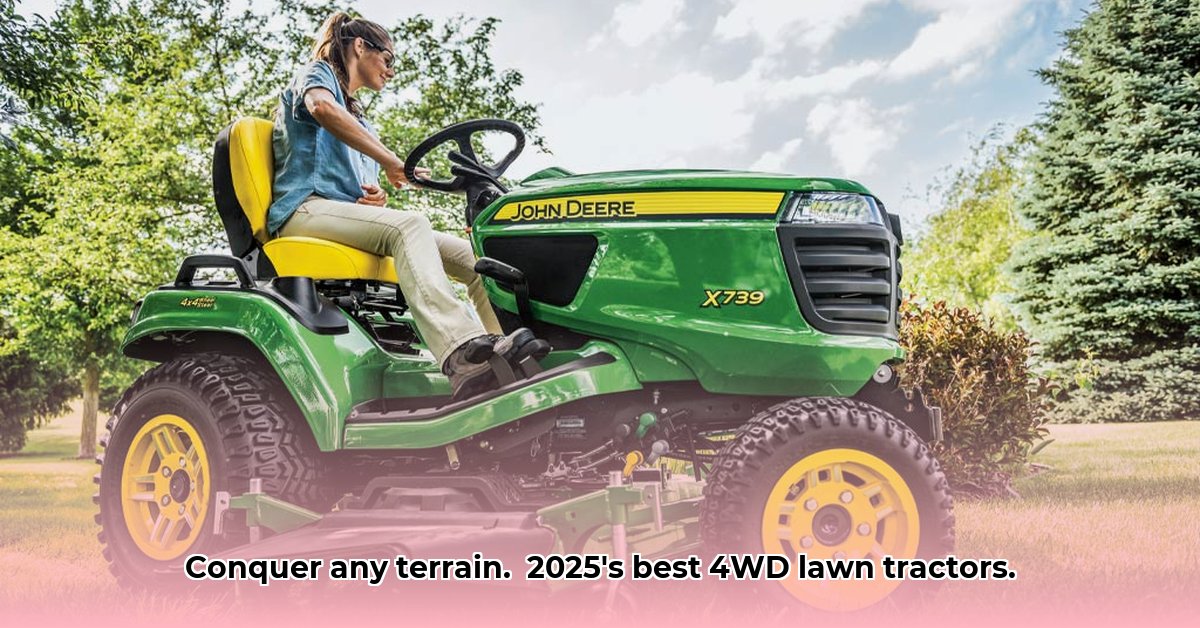
Choosing the right lawn tractor can significantly impact your yard work experience. This guide focuses on four-wheel drive (4WD) models, ideal for challenging terrains. We'll compare 4WD and 2WD tractors, explore key features, and help you select the best option for your needs and budget. For more information on maintaining your tractor, check out this helpful guide on battery sizes.
Four-Wheel Drive vs. Two-Wheel Drive: Understanding the Differences
Two-wheel drive (2WD) lawn tractors are cost-effective and easy to maintain, suited for flat, smooth lawns. However, they struggle on slopes, uneven surfaces, and in wet grass. Think of them as reliable sedans for your lawn care needs.
Four-wheel drive (4WD) lawn tractors, on the other hand, are like rugged SUVs. They offer superior traction and control on hills, uneven terrain, and wet conditions. While more expensive upfront, they provide a safer and more efficient mowing experience, especially for larger or challenging properties. This added capability comes at the cost of increased complexity and maintenance.
Key Features and Specifications: A Comparative Analysis
The table below highlights key differences between 2WD and 4WD lawn tractors:
| Feature | 2WD | 4WD |
|---|---|---|
| Drive System | Two-wheel drive (power to two wheels) | Four-wheel drive (power to all four wheels) |
| Terrain Suitability | Flat, even lawns | Hilly, uneven, wet lawns |
| Initial Cost | Lower | Higher |
| Maneuverability | Generally better in tight spaces | Can be slightly less agile, model-dependent |
| Maintenance | Typically less frequent and less costly | Typically more frequent and potentially more costly |
| Engine Power | Usually less powerful engines | Often more powerful engines |
| Cutting Deck Size | Varies; often smaller | Varies; larger decks are more common |
Performance Metrics: Real-World Comparisons
While specifications are helpful, real-world performance is crucial. 4WD tractors excel on slopes exceeding 20 degrees, where 2WD models often struggle or become unsafe. Their superior grip ensures a smoother, more even cut, even on uneven terrain. Larger cutting decks (often found on 4WD models) significantly reduce mowing time, especially for extensive lawns. However, 4WD models typically consume slightly more fuel.
Isn't it important to consider how a machine performs in realistic conditions? Isn't choosing the right mower based on your property's unique challenges a crucial decision?
Cost-Effectiveness: A Long-Term Perspective
4WD tractors have a higher initial purchase price. However, consider the long-term costs. Continuously using a 2WD on challenging terrain accelerates wear and tear, leading to more frequent and expensive repairs. The initial cost savings can be quickly negated. Regular maintenance (oil changes, filter replacements, blade sharpening) remains consistent across both types, but 4WD systems may need additional servicing. Comparing warranties and parts availability is essential for gauging long-term costs.
Terrain Adaptability: Matching the Mower to the Lawn
For smaller, flat lawns, a 2WD is sufficient and cost-effective. Larger lawns with slopes, bumps, or consistent wetness benefit significantly from a 4WD's superior traction and safety. The enhanced grip translates to better control, reduced slipping, and increased productivity.
Buying Guide: Recommendations for Different User Profiles
- Small, flat lawn: A 2WD offers a budget-friendly solution.
- Large, flat lawn: A larger-deck 2WD maximizes efficiency.
- Hilly or uneven terrain: A 4WD is strongly recommended for safety and performance.
- Wet or muddy conditions: A 4WD with aggressive treads is essential.
Frequently Asked Questions (FAQ)
- Q: How often should I service my 4WD lawn tractor? A: Consult your owner's manual; 4WD models typically require more frequent maintenance than 2WD models.
- Q: Are 4WD lawn tractors harder to maneuver? A: While some models might be slightly less agile in tight spaces, this is often minimal and not a major factor for most users.
- Q: What about fuel efficiency? A: 4WD models generally consume slightly more fuel, but this is often offset by increased performance and safety on difficult terrain.
Choosing between a 2WD and 4WD lawn tractor involves careful consideration of your yard's characteristics and your budget. This guide provides essential information to help you make an informed decision.